Funded by the Horizon Europe Programme of the European Union under grant agreement No 101096809
Funded by the Swiss State Secretariat for Education, Research and Innovation
Introduction
Methanol Facts
Methanol has a number of properties that make it a useful marine fuel.
It is liquid at ambient temperature and pressure and can therefore be
stored in normal, prismatic fuel tanks on board. The three main
disadvantages of its use are its toxicity, its low energy density -
around 20 MJ/kg as opposed to around 42 MJ/kg for diesel -
and its
low flash point of 12°C, which contributes to an increased risk of
fire and explosion. Methanol burns cleanly compared to conventional
marine diesel. No sulphur oxides are formed during combustion.
Particulate matter and soot emissions are also low; their source
tends to be the lubricants in the engine.
Methanol is lighter than water, but also highly soluble, so that
the fuel dissolves quickly in water in the event of a spill. As
it is only dangerous for aquatic organisms in very high doses and
is quickly broken down, no large‑scale environmental pollution is
to be expected in the event of a spillage, as is the case with diesel.
Methanol is today mainly produced from fossil sources (natural gas),
but can also be produced sustainable. There are various ways to
produce renewable methanol. One is to capture CO2 from
geothermal power generation which is then reacted together with
renewable hydrogen (produced via electrolysis) into renewable
methanol. Other methods are to convert biogas from fermentation
or gasification of sustainable biomass into bio-methanol as well
as producing it from solid waste feedstocks. It is also produced
as a by-product of the kraft pulping process in paper production.
Formaldehyde emissions
From the study
“
Methanol as a marine fuel – Advantages and limitations
”
by the Öko-Insitut it becomes clear that the formaldehyde emissions
from methanol engines are a field that still requires research,
but might be easily overcome with appropriate exhaust gas
aftertreatment:
“Formaldehyde (CH2O) emissions can also occur in the
exhaust gas from marine engines and represent a significant risk to
human health given its carcinogenic properties. According to
AakkoSaksa et al. (2023), CH2O emissions result from
the incomplete combustion of a carbon-containing fuel.
These emissions generally vary depending upon different variables,
such as the engine and the fuel used. The following values from
literature have been compiled by Aakko-Saksa et al. (2023):
Medium speed diesel marine engines using HFO or distillate fuels
(MGO) reported average emission factors for CH2O ranging
from 0.017–0.048 g/kWh.
For a DF natural gas (LNG) engine, an average emission factor
for CH2O of 0.189 g/kWh was reported.
For a DF methanol engine, the CH2O emissions reported
have been negligible (0.00049 g/kWh) and also low for small
alcohol diesel HSD engines using methanol additised with an
ignition improver (0.004–0.014 g/kWh).
In contrast, Güdden et al. (2021) came to a very different
conclusion regarding the significance of CH2O emissions
associated with the performance of a high speed marine engine
converted from a diesel to a methanol combustion system. The
experiment revealed comparably high formaldehyde emissions (~1 g/kWh).
Hence, Güdden et al. (2021) suggest that the use of an oxidation
catalyst should be obligatory in the future and that the additional
effort required should be “manageable” as the catalyst technology
required for the reduction of formaldehyde is not as sophisticated
as that for natural gas engines due to the stability of the
methane molecule. CIMAC (2014) and Verhelst et al. (2019) also
suggest already available oxidation catalysts to reduce
CH2O emissions from marine engines. The number of s
tudies on formaldehyde emissions from marine methanol engines
is limited. Therefore, further research will be required to
comprehensively determine CH2O emission levels from
different engines, the associated level of health risks posed using
methanol as a marine fuel and the need for mitigating actions.
The conclusions from the two studies cited above may reflect the
fact that they focus on different engine types and sizes, but
further comparison is beyond the scope of this study. Except for
the uncertainties around CH2O, methanol has a lower
emissions impact.”
Emissions
When talking about emissions, there are initially different ways
of looking at them: On the one hand, a distinction is made between
toxic and climate-impacting emissions. On the other hand, a
distinction is made between local and global emissions. Examples
of toxic emissions are nitrogen oxides, particulates, formaldehyde,
etc., while climate-impacting emissions include CO2,
methane, laughing gas, etc. Local emissions have effects on the
immediate surroundings of the source, such as toxicity. The effects
of global emissions are not limited locally; they can be
climate-impacting substances, for example, or the now banned CFC,
which damages the ozone layer or sulphur emissions from the seagoing
sector. The following table shows the relevant emissions for this
fact sheet.
Emission compared to conventional diesel
Local
Global
GHG
The global GHG emissions are dependent on the methanol source.
- neutral
NOX
better
SOX
PM
If the emissions caused by a propulsion technology or an energy
source are to be assessed, there are again various approaches.
The most common are the well-to-wake and the tank-to-wake approach.
In the well-to-wake approach, the emissions from the entire upstream
chain required for the production and supply of an energy carrier
are considered. For an engine, a fuel cell or a battery this
approach is called Life-Cycle-Analysis. The tank-to-wake approach
looks at the emissions generated by the ship during use. Everything
that happened before the energy carrier, storage system or energy
converter came on board is excluded.
These two definitions can produce very different results in the
assessment of the technologies. For example, when considering the
overall chain, the choice of a methanol combustion engine could
be better than that of a battery-electric drive. This is the case
if the production of the battery causes more emissions than the
combustion of methanol. It is important to note that this type
of consideration is also different for each ship and depends on
its operating time and energy requirements.
Regulations
ES-TRIN
Under the ES-TRIN 2025 framework, derogations would only be necessary
in case of solutions for methanol storage and engine room design
technically deviating from the requirements laid down in Chapter 30
(in particular risk assessment and safety organisation), Annex 8,
Section II, Chapter 2 (fuel storage methanol) and
Annex 8, Section III, Chapter 3
(engine room design methanol).
ADN
Methanol propulsion systems in compliance with the requirements of
ES-TRIN 2025 are covered by the general exemptions of paragraphs
7.1.3.31 (use of engines) and 9.x.0.31 (rules for construction),
meaning that a separate derogation in accordance with section 1.5.3
of the ADN would not be necessary.
However, for methanol propulsion systems benefitting from a
derogation under the ES-TRIN framework, an additional derogation
under the ADN framework would be required for vessels intended to
carry dangerous goods.
Methanol, UN 1230, is permitted to be carried in tank vessels
as cargo in type N tank vessels, closed, integral cargo tank,
water-spray system. Methanol is assigned to temperature class T2
and explosion group IIA, anti-explosion protection is required.
Passenger Vessels
There are no specific requirements applicable to passenger
vessels with methanol propulsion systems, however, the presence
of passengers on board has to be taken into account in the risk
assessment to be performed in compliance with Article 30.04 of
the ES-TRIN.
IMO Rules
For seagoing ships, the IMO Circular 1621 “Interim guidelines for
the safety of ships using methyl/ethyl alcohol as fuel” contain
functional requirements for all appliances and arrangements.
Currently, the introduction of methanol and hydrogen internal
combustion engines for the inland waterway sector faces on major
barrier: so far, methanol and hydrogen have not yet been included
as reference fuels in the NRMM directive. This means for the OEM
that it is not allowed to bring these engines on the market.
In ES-TRIN 2025, no type approval for the engine required under
exemption in accordance with Article 9.01 (6) with the restriction
that the inland navigation vessel certificate shall not be valid
for longer than the duration of the field test in accordance
with Article 34 of the NRMM-Regulation. (This is of course still
a major limitation as an INVC can only be obtained for a duration
of 24 months with a single possible extension of
another 24 months – in total only 4 years with currently
no perspectives for further legal operation).
Technical Concept
Engine Types
When methanol is used as fuel for an internal combustion engine,
several design challenges are to be met. First, methanol is a low
flashpoint fuel which means that the regulations for the use of
low flashpoint fuels on board vessels must also be complied with.
In addition, the methanol flame is virtually invisible in daylight.
This can pose a safety risk for the crew and special sensors would
also have to be used for detection; for example, infrared cameras
or temperature measurement would be suitable. One advantage of
burning methanol is that the flame temperature is significantly
lower than that of diesel and water can be used very well as an
extinguishing agent. In contrast to diesel, methanol is
significantly more corrosive, and the lubricating effect of alcohol
is also significantly poorer than that of diesel. The metals and
rubbers that encounter methanol must therefore be selected very
carefully. This also applies to spare parts in later use. The
following engine concepts are relevant for the use of methanol
as fuel in marine applications. For the dual fuel concepts the
baseline is to replace 50 % to 80 % (energy ratio) of
diesel with methanol. The following engine concepts are relevant
for the use of methanol as fuel in marine applications:
Dual fuel high pressure direct injection (DF-HPDI) as 2-stroke
and as 4-stroke.
Dual fuel port injection (DF-PI)
Port injection spark ignited (SI)
Compression ignited, with ignition improver (CI)
DF-HPDI - Dual Fuel High Pressure Direct Injection
A four-stroke engine has both inlet and exhaust valves in
the cylinder head, typically two of each. The fuel injection
valve is placed in the centre and there is normally no space
available to fit another fuel injection valve.
The injection mechanism can be controlled in several
different ways, either by hydraulic pressure (oil), solenoid
or a piezoelectric controller. The illustration below shows
the operation of a 4-stroke dual fuel high pressure direct
injection methanol engine.
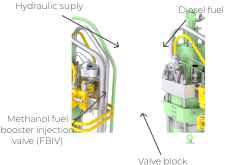
Cylinder head of a methanol engine. Source: MAN Energy Solution.
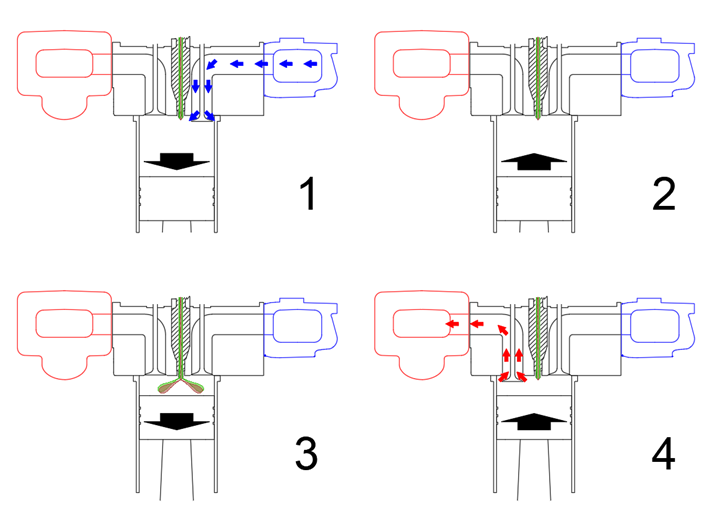
The combustion principles of a 4-stroke diesel engine
with combined methanol and diesel pilot injector.
The piston moves down, and air enters the cylinder.
The piston moves up and compresses the air,
temperature and pressure are increased.
Close to TDC the fuel is injected, the diesel pilot fuel a
fraction before the methanol, The piston is then pushed down
by the expansion of the hot gases.
The emission gases are pushed out through the exhaust valve.
Emissions of particles are heavily reduced and limited to the
pilot diesel. NOx emissions are on IMO Tier III levels without
exhaust gas aftertreatment. The fraction of unburnt fuel and thereby
formaldehyde emission are very low.
As methanol is injected to the ongoing combustion at TDC the
cylinder liner and air channels are not exposed to methanol.
Likewise blow-by gases should not contain methanol that could
increase decomposition of lubricating oil in the crank case.
Modifications to the engine should be limited to the fuel injection
system with full flexibility to operate on conventional diesel
fuel with no loss of performance.
DF-PI - Dual Fuel Port Injection
All major marine engine suppliers have dual fuel engines where
methane gas (LNG) can replace a significant part of the HFO or
MGO. Especially for large 2-stroke engines this is a proven and
reliable technology. The same concept can be used for methanol
by replacing the gas valve with a methanol injector. This methanol
injector is placed upstream of the inlet valve.
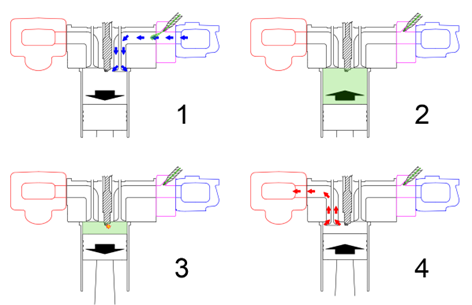
The combustion principles of a 4-stroke port injected
engine with diesel pilot ignition.
The piston moves down; methanol injects from the port
with inlet air.
The piston moves up and compresses the air-methanol
mixture, temperature and pressure are increased.
Close to TDC the diesel is injected as pilot fuel and
ignites the compressed methanol air mix in the cylinder.
The piston is then pushed down by the expansion of the
hot gases.
The emission gases are pushed out through the exhaust valve.
On diesel mode, the engine runs as normal diesel. When switch to
methanol mode, the engine runs on Otto cycle. The main fuel is
injected from the methanol injector and into the combustion
chamber with intake air, and a burst of pilot fuel initiates the
combustion at top dead centre (TDC).
Dual fuel engines normally operate on lean mixtures in methanol mode
as the pilot fuel is sufficient to ensure combustion. This allows for
higher compression ratio and thus higher efficiency.
Port Injection Spark Ignited (SI)
The spark ignition (SI) concept is similar to the port injection
dual fuel concept, but uses spark plugs to replace the function
of diesel injectors. The advantage with the spark plug is that n
o other fuel is needed to initiate the combustion, but it also
limits the flexibility as dual fuel operation is not supported.
The ignition power of a spark plug is also much lower than the
ignition power from pilot fuel. This limits the size of engines
where an open spark plug can be used for ignition of combustion.
For larger engines, the spark plug is placed in a pre-chamber
where a small part of the fuel mix is ignited. This ignited fuel
mix generates a jet that ignites the rest of the fuel. Compared
to a dual fuel engine the compression ratio is lower to prevent
knocking. Combustion temperatures are kept low with a lean fuel/air
mixture and emissions are comparatively low.
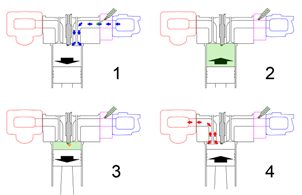
The combustion principles of a 4-stroke engine with port
injection and spark ignition
The piston moves down, methanol injects from the port with inlet air.
The piston moves up and compresses the air-methanol mixture,
temperature and pressure are increased.
Close to TDC the spark plug ignites methanol. The piston is
then pushed down by the expansion of the hot gases.
The emission gases are pushed out through the exhaust valve.
Compression ignited, with ignition improver (CI)
The low cetane number and high-octane number of pure methanol
makes it more suitable for spark ignited Otto combustion.
However, by adding an ignition improver the characteristic of
methanol is changed so it can be used as single fuel in a
compression ignited engine. Scania developed this concept for
ethanol in the 1980s and have used it extensively for busses
and trucks were. Ethanol and methanol have similar combustion
characteristics and the concept has now been adopted for
marine and industrial compression ignited methanol engines.
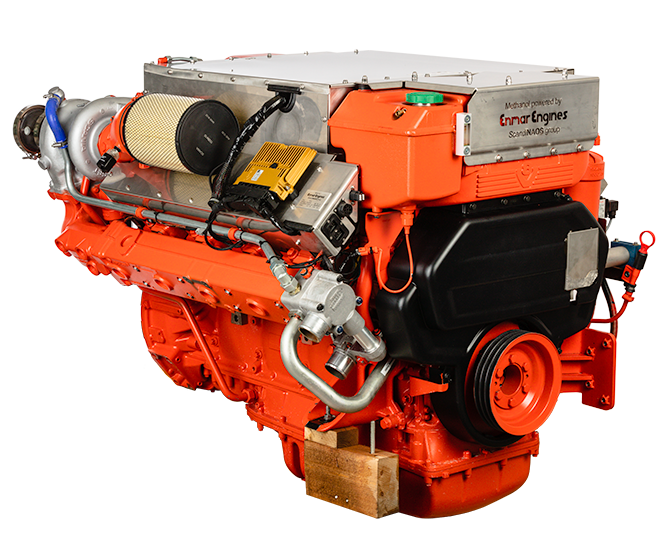
Compression ignited methanol (MD97) engine 16LV8 415 kW
at 2100 rpm, available from Enmar Engines AB. Source: ScandiNAOS
The concept is based on the modification of Scania marine and
industrial engines by using original Scania components from their
ethanol (ED95) bus and truck engines.
Today Enmar Engines are selling compression ignited methanol
engines that uses MD97 fuel. The fuel contains methanol and 3 %
Beraid ignition improver as well as a small fraction of lubricant.
The engines are based on the Scania marine engines with several
modifications, including alcohol fuel injectors and higher
compression ratios. With the ignition improver, the engine can
run on diesel cycle with methanol and provides similar performance
as a diesel engine with high efficiency and fulfils IMO Tier III
NOX emission levels without after treatment system.
Within SYNERGETICS the two options Compression ignited, with
ignition improver (CI) and the Dual fuel port injection (DF-PI)
will be compared.
Equipment for Methanol Powered Vessels
Tanks
Due to the corrosiveness, materials for piping and tanks need to
be selected carefully. Stainless steel or appropriate coatings are
proven solutions.
For inland vessels the following aspects are to be considered
form ES-TRIN 2023:
Methanol tanks can be either inerted or non-inerted.
Secondary barrier required for all equipment and piping containing
liquid methanol fuel, except on open deck.
Designed to prevent electrostatic charges.
Methanol tanks not to be located forward of the collision
bulkhead and aft of the aft-peak bulkhead.
Distance of methanol tanks in general not less than 0,60 m
to vessel’s side and 0,50 m to vessel’s bottom.
Tank venting to be equipped with suitable flame arrestors.
Gas detection systems required for spaces where fuel vapours
may accumulate.
For coastal vessels the Circular 1621 states that:
Methanol fuel tanks can be either portable or fixed.
All fuel tanks should be inerted at all times during normal operation.
Fuel Preparation Space
The fuel preparation space can either be a dedicated room or a
cabinet that are both gas-tight separated from other spaces. In
the fuel preparation space, the single-walled pumps, valves,
filters, etc. create a hazardous area that therefore needs a
second barrier.
Engine Room
For inland waterway vessels there are two options for engine
room design: The gas safe and the ventilated engine room.
In the following, some of the main characteristics of the two
concepts are listed.
Gas Safe Engine Room
Gas safe under all conditions (“inherently safe concept”). A
single failure within the methanol system shall not lead to a
leakage of methanol into the engine room.
Methanol piping and equipment within the engine room boundaries
surrounded by a secondary barrier for leakage containment and
detection.
Methanol leakage inside the ventilated ducts or enclosures shall
be detected by means of suitable detectors.
Methanol leakage must be safely collected and drained by means
of leakage collecting arrangements.
Ventilated Engine Room
Possible hazardous areas within the ventilated engine rooms shall
be classified in accordance with EN 60079-10-1 : 2020 und
EN 60079-10-2 : 2015.
Only equipment suitable for the hazardous areas as classified is
permitted. This shall be deemed to be fulfilled if the equipment
meets the relevant provisions of the European Standard series
EN 60079.
Ventilated engine rooms shall be designed to provide a geometrical
shape that minimises gas release from leakage pools as well as
the accumulation of gases or formation of gas pockets. Good air
circulation shall be ensured. Air inlets and outlets shall be
located in appropriate positions, taking into account the
characteristics of methanol.
Suitable alarms shall be provided to detect and indicate a leakage
in the engine room, by means of liquid detectors and high
sensitivity gas detectors at suitable places.
Drip trays with self-draining lines to closed collecting tanks
shall be provided under all equipment which contain methanol and
from where leakage cannot be excluded.
Spray guards shall be provided on pipes and joints where fuel
spray cannot be excluded.
According to Circular 1621 the engine rooms of coastal vessels
shall fulfil the following requirements:
A single failure within the fuel system should not lead to a
release of fuel into the machinery space.
All fuel piping within machinery space boundaries should be
enclosed in gas and liquid tight enclosures […].
Special Safety & Other Requirements
Bunkering
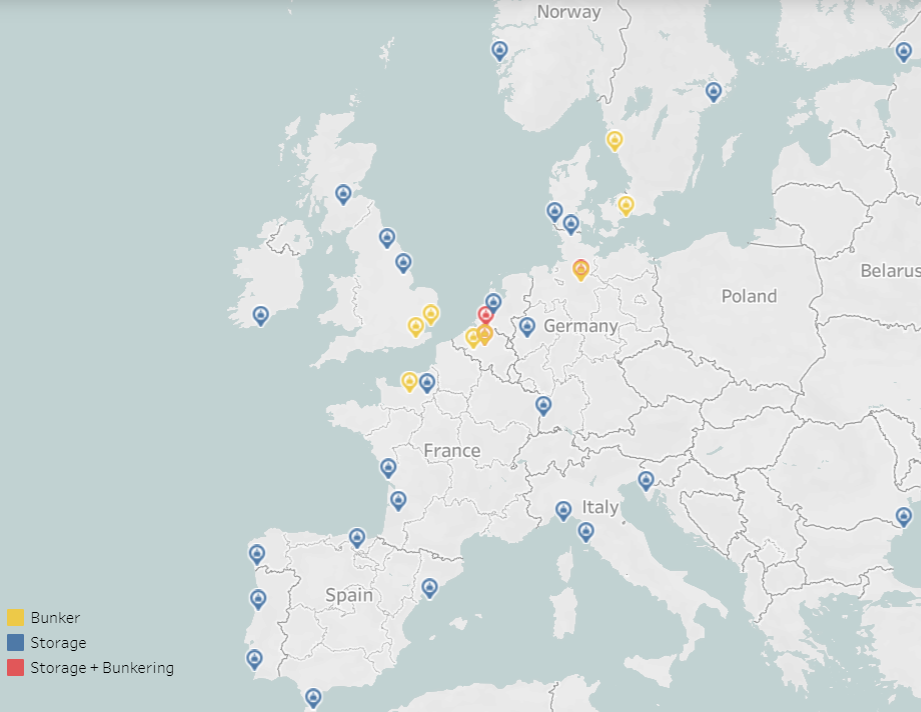
The Methanol Institute provides a map (see
) with the
large methanol bunker and storage facilities. Nonetheless, the
current option for most coastal and inland ships will be the
bunkering via truck.
For seagoing vessels there are already guidelines on bunker
procedures available, e. g.,
Lloyd’s Register,
ABS,
or the Port of Gothenburg.
As of today, 10/2024, no bunker guidelines for inland vessels are available.
Large methanol bunker and storage facilities in Europe.
Economics
Investments Costs
The investment for a methanol engine is between 500 €/kW and
700 €/kW. The installation cost is dependent on the vessels size
nd is approximately around 50,000 €.
Operational Costs
The price for grey methanol is around 400 €/t at in Rotterdam. Current
estimations give the name the price for green methanol three times higher.
The maintenance cost for the system is about 7% of the investment.
Considerations for Deployment
Strongly dependent on the infrastructure that is yet under construction.
Training of personnel.
Restrictive safety rules.
Risk assessment is necessary (e. g. HAZID study).
Bunker process.
Deployment Examples
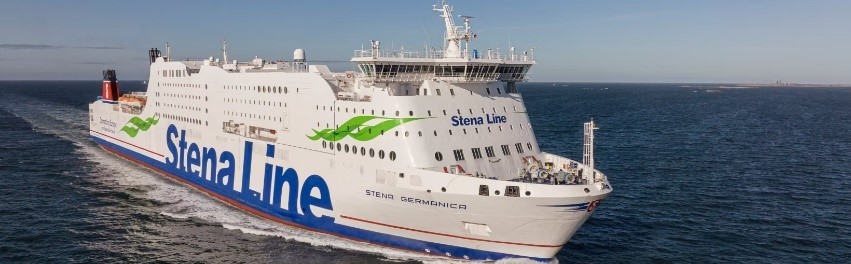
Stena Germanica
Source: Stena Line.
Vessel type
Ferry
IMO
9145176
Vessel Size
241.0 m × 28.7 m
Build Year
2001
Propulsion
4 x Sulzer 8ZAL40S diesel engines with 23 000 kW total
The content of the publication herein is the sole responsibility of the publishers and
it does not necessarily represent the views expressed by the European Commission or its
services. While the information contained in the document is believed to be accurate,
the author(s) or any other participant in the SYNERGETICS consortium make no warranty
of any kind with regard to this material including, but not limited to the implied
warranties of merchantability and fitness for a particular purpose. Neither the
SYNERGETICS Consortium nor any of its members, their officers, employees or agents
shall be responsible or liable in negligence or otherwise howsoever in respect of
any inaccuracy or omission herein.




 better