Funded by the Horizon Europe Programme of the European Union under grant agreement No 101096809
Funded by the Swiss State Secretariat for Education, Research and Innovation
Introduction
Not only can hydrogen be used for a fuel cell but also for various forms of the
classic internal combustion engine (ICE). Lately manufacturers have started the
development of commercially available monofuel hydrogen combustion engines.
In contrast to the fuel cell or the battery, no rare‑earth metals are needed to
produce the combustion engine. An internal combustion engine burning hydrogen
can work on the Diesel or the Otto cycle. Additional benefits are that combustion
engines are cheap, can use lower quality fuel and are more easily maintained with
the existing dealer/support network (compared to fuel cells). As they represent
a variation to existing technology rather than a completely new power source,
the acceptance by the wider industry may also be easier.
Emissions
When talking about emissions, there are initially different ways of looking at them:
On the one hand, a distinction is made between toxic and climate‑impacting emissions.
On the other hand, a distinction is made between local and global emissions.
Examples of toxic emissions are nitrogen oxides, particulates, formaldehyde, etc.,
while climate‑impacting emissions include CO2, methane, laughing gas, etc.
Local emissions have effects on the immediate surroundings of the source,
such as toxicity. The effects of global emissions are not limited locally;
they can be climate‑impacting substances, for example, or the now banned CFC,
which damages the ozone layer or sulphur emissions from the seagoing sector.
If the emissions caused by a propulsion technology or an energy source are to
be assessed, there are again various approaches. The most common are the
well‑to‑wake
and the tank‑to‑wake approach. In the well‑to‑wake approach,
the emissions from the
entire upstream chain required for the production and supply of an energy carrier
are considered. For an engine, a fuel cell or a battery this approach is called
Life‑Cycle‑Analysis. The tank‑to‑wake approach looks at
the emissions generated
by the ship during use. Everything that happened before the energy carrier,
storage system or energy converter came on board is excluded. These two definitions
can produce very different results in the assessment of the technologies.
For example, when considering the overall chain, the choice of a methanol
combustion engine could be better than that of a battery-electric drive. This is
the case if the production of the battery causes more emissions than the
combustion of methanol. It is important to note that this type of consideration
is also different for each ship and depends on its operating time and energy
requirements. The following table shows the relevant emissions for this fact sheet.
Emission compared to conventional diesel
Local
Global
GHG
The global GHG emissions are dependent on the hydrogen source.
NOx
- neutral
-
SOx
better
PM
-
-
Regulations
Currently, the introduction of hydrogen internal combustion engines
for the inland waterway sector faces one major barrier: so far, hydrogen
has not yet been included as reference fuels in the NRMM directive. This
means for the OEM that it is not allowed to bring these engines on the
market. In ES‑TRIN 2025, no type approval for the engine required under
exemption in accordance with Article 9.01 (6) with the restriction that
the inland navigation vessel certificate shall not be valid for longer
than the duration of the field test in accordance with Article 34 of
the NRMM‑Regulation. (This is of course still a major limitation as
an INVC can only be obtained for a duration of 24 months with a single
possible extension of another 24 months – in total only 4 years with
currently no perspectives for further legal operation).
It is not clear how this impacts an engine which could be operated in
‘normal’ diesel (and is compliant with stage V) and which could also
operate in dual fuel mode.
The technical requirements for the storage of hydrogen are foreseen in
ES‑TRIN 2027 Chapter 30, Annex 8, Sections 2.3 and 3.4..
Passenger Vessel
So far, there are no specific requirements foreseen for passenger vessels
with H2 propulsion systems, however, the presence of passengers
on board has to be taken into account in the risk assessment to be
performed in compliance with Article 30.04 of the ES‑TRIN.
ADN
H2 propulsion systems will be covered by the general
exemptions of paragraphs 7.1.3.31 (use of engines) and 9.3.1.31
(rules for construction) once the respective requirements are adopted,
meaning that a separate derogation in accordance with section 1.5.3
of the ADN would not be necessary.
However, for H2 propulsion systems benefitting from a
derogation under the ES‑TRIN framework, an additional derogation
under the ADN framework would be required for vessels intended to
carry dangerous goods.
Technical Concept
Hydrogen as Fuel
Hydrogen is typically supplied commercially in a form suitable for
fuel cell applications which have a very high purity requirement
such 99.999 (the so called “Five 9’s”). This makes the production,
processing, and handling of hydrogen more expensive in order to maintain
this high purity grade. Combustion engines have the attractive quality
that they are able to utilise hydrogen at much lower purity levels.
The lower purity requirement also means there may be a possibility
to use other green fuels such as green ammonia as a storage vector
for the hydrogen which can be dissociated at the point of consumption.
Also the use of another hydrogen carrier such as LOHC (liquid organic
hydrogen carrier) of LICH (liquid inorganic hydrogen carrier) are
future options.
Engine Types
The wide ignition limits of hydrogen theoretically allow wider combustion
control over the entire operating range of the engine. In contrast to
conventional fuels, hydrogen can theoretically be burned homogeneously up
to an air ratio of λ = 10 (i.e. 10 times more air than is required
for stochiometric combustion which is 34:1 by mass). As with conventional
fuels, the required ignition energy increases with the air ratio. To ignite
a stoichiometric hydrogen-air mixture, only one tenth of the energy required
to ignite a gasoline-air mixture is needed. In contrast, the auto-ignition
temperature of hydrogen is significantly higher than that of conventional
liquid fuels. Due to the very low ignition energy required, hot spots and
mixing with hot gases are a particular concern for the practical control of
pre-ignition problems. Although the high autoignition temperature can bring
advantages in terms of knocking behaviour in the case of premixed combustion,
it requires very high compression ratios or other measures to increase the
charge temperature in the case of the auto-igniting hydrogen engine
(i.e. a compression ignition monofuel concept) which is why this engine
concept is currently deemed impractical. For these reasons, monofuel
engines are typically spark ignition and there are several commercially
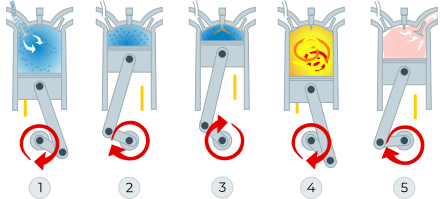
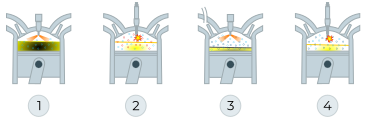
available alternatives on the market now. The
presenting a
principle of co-combustion of hydrogen-diesel in a diesel-engine while
shows four different variants of hydrogen combustion engine principles.
Hydrogen-Diesel co-combustion in a Diesel-engine.
SPI (Single Point Injection) – Hydrogen is injected upstream on the
intake so that when the intake valve opens, a fully pre-mixed homogeneous
fuel-air mix is ingested into the engine. Benefits are that the mixture
is ideal, drawbacks are that the hydrogen displaces some air in the
intake and it can be difficult to control backflash. Hydrogen supply
pressure is typically ‘low’.
PFI (Port Fuel Injection) - Hydrogen is injected directly behind the
valve into the intake air during the intake stroke. Benefits are that
backflash may be limited to one cylinder, drawbacks are that it relies
on in-cylinder mixing (challenging at higher speeds) and the timing and
control of the hydrogen system is more complex. Hydrogen supply pressure
is typically ‘medium’.
DI (Direct Injection) – Hydrogen is injected directly into the cylinder.
Benefits are that it is not possible to get backflash, drawbacks are that
in order to overcome cylinder pressure, the injection pressure must
usually be much higher which can impact useful range from the hydrogen
tanks. Hydrogen supply pressure is typically ‘high’.
During the compression stroke hydrogen mixes with air in the case of PDI
or DI type systems.
A small amount of diesel pilot fuel is injected into the combustion chamber.
Diesel auto-ignites due to the high temperature and pressure and co-combusts
with all the hydrogen, forcing the piston down during the power stroke.
The cylinder is cleaned during the exhaust stroke. Due to the hydrogen
co-combustion the CO and CO2 emissions have strongly
reduced in the exhaust gases.
Variants of hydrogen combustion engines principles.
Oxygen
Hydrogen
Gasoline
NOx
Compression ignition (Diesel cycle) has a high efficiency but emits
comparably more NOx and PM compared to spark ignition engines.
Spark ignition (Otto cycle) produces less PM and NOx but has a
lower efficiency due to throttling losses.
Co-Combustion (Diesel cycle) has a high efficiency with lower emissions
than an equivalent diesel only engine. The diffusion rate of
H2 is
comparably higher than with other gases so it mixes naturally into
a homogeneous mix.
H2 Mono-fuel (Otto cycle) can reach nearly zero-emission and
the high efficiency of a diesel engine. A high lambda value for low
NOx emissions is required. But larger engine size required
due to reduced power output
Equipment
The equipment for the H2 storage and distribution system on board consists of:
H2 Tanks (fixed or swappable, see Fact Sheet “Fuel Cells”)
Double-walled pipes, if necessary
Thermal pressure relief devices
Control valves
Pressure reduction system.
Vent system.
Purge system.
Check valves.
Refueling receptacles, etc.
Since hydrogen burns with a nearly invisible flame, detectors for flame
monitoring are needed. For bunkering operations, it is important to use
non-sparking tools.
The use of CO2 as a fire extinguishing agent is not recommended.
Small particles of dry ice are formed during discharge. The rapid flow of
particles can generate considerable amounts of static electricity, which
can act as a source of ignition.
Tank System for Compressed Hydrogen
The tanks are typically stored on deck in a safe location; storage under
deck might also be possible. From a safety point of view placing the
H2
tank-system on deck is the safest solution since ventilation and dilution
are the most important safety measures.
The hydrogen tank system typically consists of several individual
cylinders, which are combined in a multiple element gas container (MEGC)
that is connected to the ship via one fitting.
As hydrogen refuelling infrastructure in harbours is not existing, it
might be favourable to use swappable hydrogen tank solution for larger
volumes. Filling the MEGC with high-pressure hydrogen takes several
hours, blocking the ship at the port. The regulatory aspects to enable
the use of one tank-system on several ships are still being worked out.
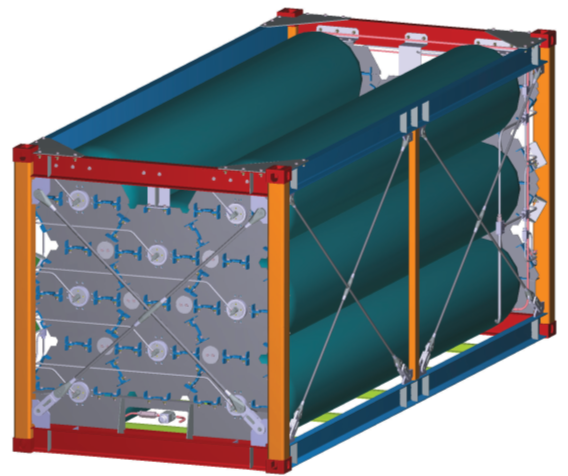
A 20 Feet Container with 500 kg of usable hydrogen with
ADR/ADN-certification is on the market. Currently there are two
pressure levels favoured by the industry: 350 and 500 bar.
500 bar H2 Tank-Tainer with 500 kg of H2.
Source: Argo-Anleg.
For smaller ships needing smaller quantities of H2, a fixed tank
system that can be refueled with a small mobile refueling station might be
a favorable option.
Special Safety & Other Requirements
The primary hazards and issues associated with hydrogen systems can be
categorised and prioritised as follows:
Flammability:
Thermal effects.
Pressure effects.
Easy ignitability of mixtures with oxidant.
Small size of the molecule:
Low viscosity.
High diffusion rate.
High buoyancy.
Interactions with materials (embrittlement of certain metals).
Asphyxiation hazard if oxygen is replaced.
Hazards associated with the storage procedure:
Elevated storage pressure for gas.
Low temperature for cryogenic liquid.
Others for other methods, such as metal hydrides.
ES‑TRIN 2023 Article 30.04 states that “a risk assessment
shall be conducted to ensure that risks arising from the use of fuels
with a flashpoint equal to or lower than 55 °C affecting people
on board including passengers, the environment, the structural strength
and the integrity of the craft, are addressed.”
A HAZID study may cover the following areas (as applicable):
General arrangement of vessels.
H2 fuel-storage arrangement and details.
H2 fuel supply and vapour-handling system, from fuel storage
to machinery spaces
H2 fuel arrangement in fuel handling room and engine room
General arrangement of the fuel-handling and engine rooms, including
their ventilation
Main engine safety concepts and vessel integration
Hazardous area classification plans.
Ventilation and vents for stored H2 fuel, fuel-supply system, machinery
space and hydrogen consumer.
H2 fuel-bunkering arrangement.
Safety systems.
Gas detection and firefighting arrangement.
Arrangements to purge or make H2 inert.
Cargo storage and its impact.
Bunkering.
Emergency Escape and Rescue.
Very good forced or natural ventilation of the areas with hydrogen is
necessary. It must also be ensured that EX zones are formed around
installation locations and ventilation outlets.
Crew Skills
As of today, there is no official certificate for training personnel on
the hydrogen. Nonetheless, the crew must be trained and certified to be
able to use the hydrogen system on bord, be familiar with the detection
of leaks and the partial system shutdown procedures. Especially also for
the swapping process of hydrogen tank systems on ships. Currently, the
manufacturer of the hydrogen tank-system must propose a dedicated training
to the crew.
However, CESNI has developed guidelines (recommendations) concerning
competences required for operation of craft using methanol as a fuel and
for operation of craft with an electrical power supply for propulsion.
Similar recommendations are currently being developed for operation of
craft using hydrogen as a fuel.
Crew training procedures or H2Barge2 and Antonie were composed by the
following chapters:
Familiarity with physical and chemical properties of fuels aboard
ships subject to the ES‑TRIN and IGF Code.
Operate the controls of fuel related to propulsion plant and
engineering systems, services and safety devices on ships subject
to the ES‑TRIN and IGF Code.
Plan and monitor safe bunkering, stowage and securing of the fuel
on board ships subject to the ES‑TRIN and IGF Code.
Take precautions to prevent pollution of the environment from the
release of fuels found on ships subject to the ES‑TRIN and IGF Code.
Monitor and control compliance with legislative requirements.
Take precautions to prevent hazards.
Apply occupational health and safety precautions and measures on
board a ship subject to the ES‑TRIN and IGF Code.
Economics
The investment and operating costs are highly dependent on the individual
ship and its operational profile. Nevertheless, there are key figures
for some components. These are linked to a database so that they are
updated as soon as new information is available.
Investment Costs
The investment for the hydrogen engines is between 600 € and
700 € per kW. For the H2 storage 800 €/kg is
a guiding value.
Operational Costs
Currently, the price for Hydrogen is between 10 € and 16 € per kg.
A level to get near the diesel price would be between 4.5 €/kg and
6 €/kg.
Consideration before Deployment
Being carbon-free, makes the hydrogen operation of the combustion engine
at least theoretically CO2, CO and hydrocarbon-free.
In real operation, however, traces of hydrocarbons in the exhaust
gas can be detected due to lubricating oil in the combustion chamber
(it should be noted in that in the case of vehicles, monofuel combustion
engines are classed as zero emissions). The local emission of nitrogen
oxides, though, must be considered. The formation of nitrogen oxides in
combustion can, for example, be greatly reduced by appropriate regulation.
The remaining nitrogen oxides in the exhaust gas are then converted by
a catalyst (SCR) which is a well-known technology.
Deployment Examples
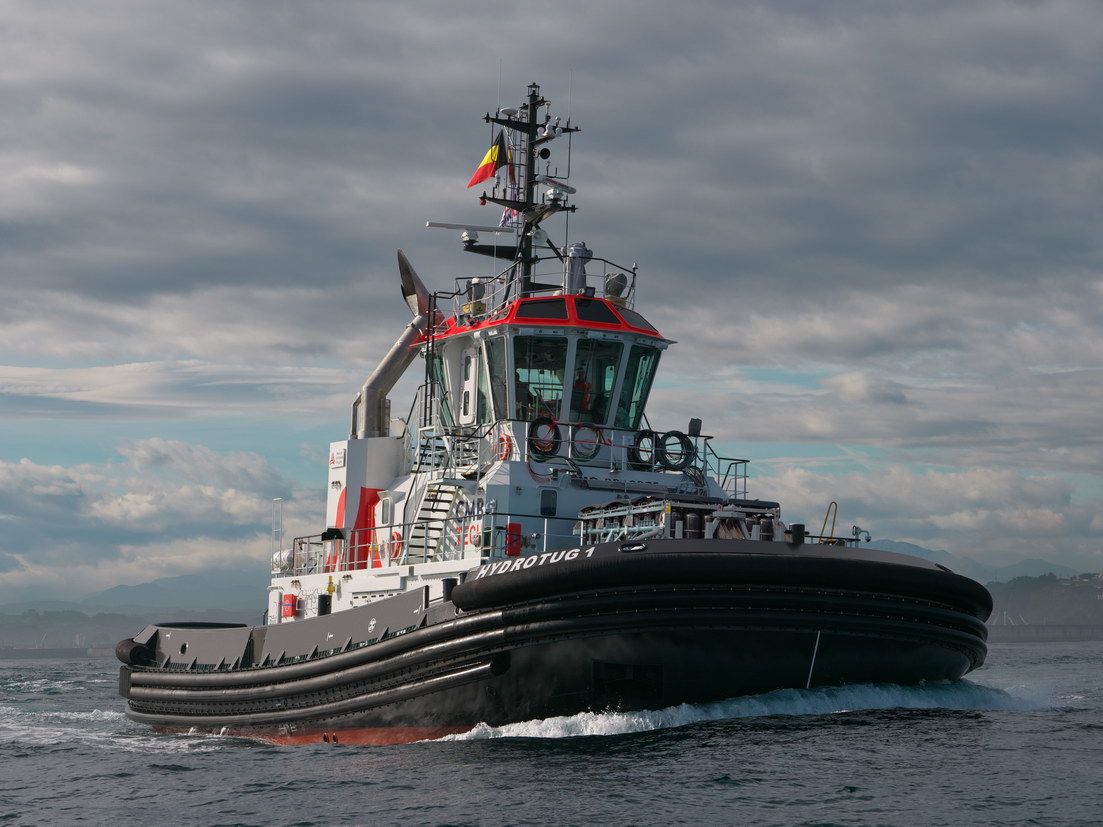
Hydrotug 1
Source: cmb.tech
Vessel type
Tug boat
IMO
9940875
Vessel Size
30.17 m × 12.5 m
Build Year
2023
Propulsion
2 x 2 MW -
BeHydro V12 dual-fuel medium-speed engines, Stage V
Hydrogen Storage
415 kg, in 54 gas cylinders
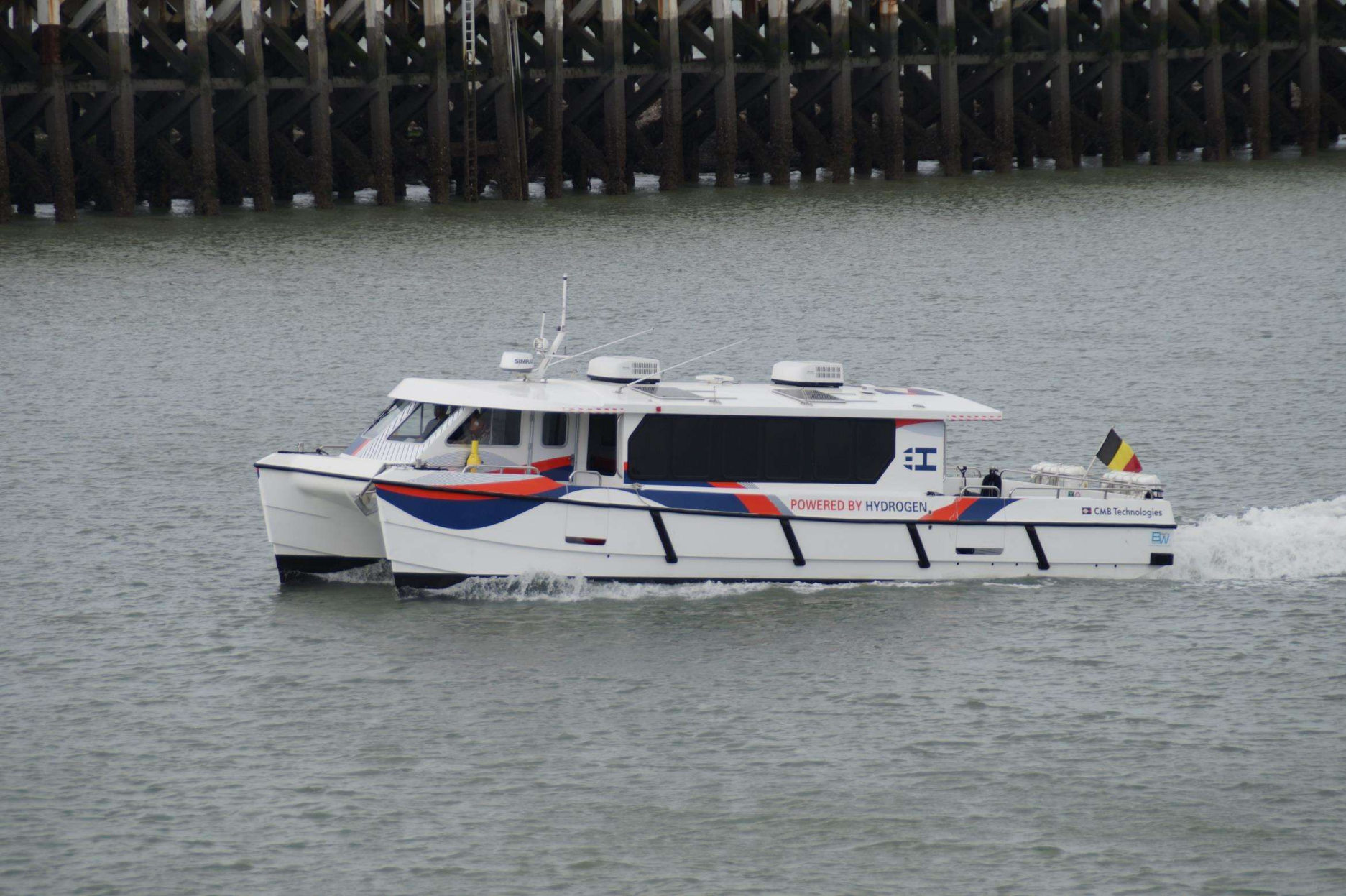
Hydroville
Source: cmb.tech
Vessel type
Passenger Shuttle
IMO
9842578
Vessel Size
14 m × 4.2 m
Build Year
2017
Propulsion
2 x 441 kW
Volvo Penta D4-300.
Hydrogen Storage
36 kg
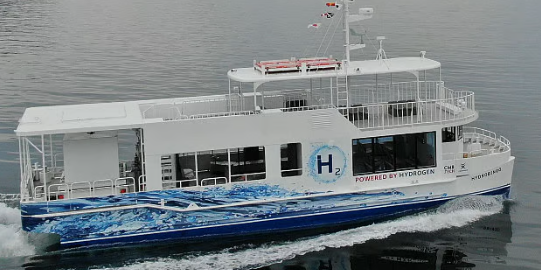
HydroBingo
Source: VESSEL REVIEW | HydroBingo – World’s first hydrogen ferry
starts operating in Japan (picture), Hydro BINGO, the first
hydrogen-powered ferry, has been presented|PRESS RELEASE|JPNH2YDRO CO., LTD.
Vessel type
Ferry
IMO
Vessel Size
19.4 m × 5.4 m
Build Year
Propulsion
2 x 441 kW dual fuel engines
Hydrogen Storage
Mobile trailer on board.
Project Coordinator
DST - Development Centre for Ship Technology and Transport Systems
Partners
SPB – Stichting Projecten Binnenvaart (NL)
Scandinaos AB (SE)
MARIN – Maritime Research Institute Netherlands (NL)
The content of the publication herein is the sole responsibility of the publishers and
it does not necessarily represent the views expressed by the European Commission or its
services. While the information contained in the document is believed to be accurate,
the author(s) or any other participant in the SYNERGETICS consortium make no warranty
of any kind with regard to this material including, but not limited to the implied
warranties of merchantability and fitness for a particular purpose. Neither the
SYNERGETICS Consortium nor any of its members, their officers, employees or agents
shall be responsible or liable in negligence or otherwise howsoever in respect of
any inaccuracy or omission herein.