Funded by the Horizon Europe Programme of the European Union under grant agreement No 101096809
Funded by the Swiss State Secretariat for Education, Research and Innovation
Introduction
This fact sheet offers information on drop-in fuels that
can be used in pure form or as a blend replacing conventional diesel without
major engine conversions. Depending on the feedstock and upstream chain
of the fuel production it can contribute to the decarbonisation of inland
shipping significantly. Information on economics and environmental
sustainability as well as references to recent applications is given here.
Emissions
When talking about emissions, there are initially
different ways of looking at them: On the one hand, a distinction is made
between toxic and climate-impacting emissions. On the other hand, a distinction
is made between local and global emissions. Examples of toxic emissions are
nitrogen oxides, particulates, formaldehyde, etc., while climate-impacting
emissions include CO2, methane, laughing gas, etc. Local emissions have effects
on the immediate surroundings of the source, such as toxicity. The effects of
global emissions are not limited locally; they can be climate-impacting
substances, for example, or the now banned CFC, which damages the ozone layer
or sulphur emissions from the seagoing sector.
If the emissions caused by a propulsion technology or
an energy source are to be assessed, there are again various approaches.
The most common are the well-to-wake and the tank-to-wake approach. In the
well-to-wake approach, the emissions from the entire upstream chain required
for the production and supply of an energy carrier are considered. For an engine,
a fuel cell or a battery this approach is called Life-Cycle-Analysis.
The tank-to-wake approach looks at the emissions generated by the ship
during use. Everything that happened before the energy carrier, storage
system or energy converter came on board is excluded. These two definitions
can produce very different results in the assessment of the technologies.
For example, when considering the overall chain, the choice of a methanol
combustion engine could be better than that of a battery-electric drive.
This is the case if the production of the battery causes more emissions
than the combustion of methanol. It is important to note that this type
of consideration is also different for each ship and depends on its operating
time and energy requirements. The following table shows the relevant
emissions for this fact sheet.
Emission compared to conventional diesel
Local
Global
GHG
The global GHG emissions are dependent on the methanol source.
- neutral
NOX
better
SOX
PM
Facts
X to Liquid (XTL)
XTL fuels (also known as Fischer-Tropsch fuels) are various synthetic
fuels that convert a solid or gaseous energy carrier into a carbonaceous
fuel, which is liquid at normal temperature and pressure levels.
The "X" is a variable and is replaced by an abbreviation of the
original energy carrier, while "TL" stands for "to Liquid".
The abbreviations GTL (Gas-to-Liquid) for the use of natural
gas or biogas, BTL (Biomass-to-Liquid) for the use of biomass
and CTL (Coal-to-Liquid) for the use of coal as a source of
energy are currently used. Synthetic fuel produced entirely
from renewable energy sources is called PTL. Here the P stands
for power. An electrolyser is operated with electricity generated
from renewable sources to separate hydrogen. Then, again using a
Fischer-Tropsch process, a synthetic, diesel-like fuel is produced
from the hydrogen and added carbon. The output of today’s PTL
refineries is still very low; and therefore, an immediate switch
to this fuel is unfeasible. However, as market interest in this
fuel increases, it can be expected that production capacity will
increase significantly.
Hydrotreated Vegetable Oil (HVO)
HVO is a mixture of straight-chain and branched paraffins, the
simplest form of hydrocarbon molecules under the aspect of clean and
complete combustion. Typical carbon numbers are C15 ... C18. In addition
to paraffins, fossil diesel fuels contain also significant amounts of
aromatics and naphthenes. Aromatics impair a clean combustion. HVO,
on the contrary, does not contain aromatics, and its composition is
similar to that of GTL and BTL diesel fuels, which can be produced by
the Fischer-Tropsch synthesis from natural gas and gasified biomass.
Biodiesel
Biodiesel, chemically fatty acid methyl ester (FAME), is a fuel that
is equivalent in use to mineral diesel fuel. The chemical industry
produces biodiesel by transesterifying vegetable or animal fats and
oils with monohydric alcohols such as methanol or ethanol. Biodiesel
mixes with conventional diesel in any ratio. Many countries therefore
use biodiesel as a blending component for conventional diesel fuel.
The quality of FAME is known to depend on the properties of the
feedstock used. Storage stability for FAME is challenging, the
product being subject to aging and decomposition during storage.
Ester type biodiesel may promote microbial growth. This requires
a very good cleaning and maintenance of tanks and equipment, and makes
the market hesitant.
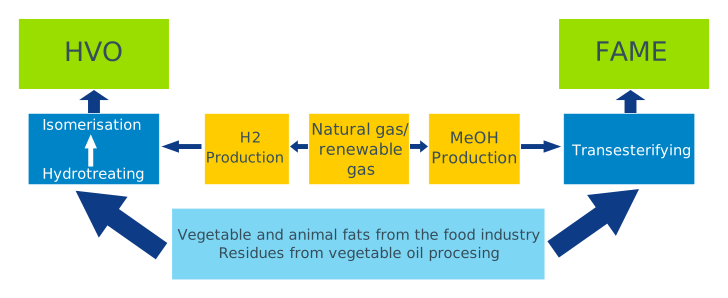
Production Process of HVO and FAME.
As it can be seen within the graphic illustration, the process of HVO
production differs from the production process for biodiesel (FAME),
as it is a catalytic process with hydrogen (hydrogenation); compared
to the esterification process used for FAME production.
Regulations
Product Specifications
For paraffinic diesel fuels the standards EN 15940, CEN TS 15940 apply.
For FAME it is EN 14214 . The standards EN590, ASTM D975, World-wide
Fuel Charter (Category 4) define the contents of fossil fuel.
Latest regulations regarding use as IWT fuel
The regulations applicable for inland vessels are under the
ES-TRIN /NRMM/RED regime:
Directive (EU) 20018/2001 of the European Parliament and of the
Council of 11 December 2018 on the promotion of the use of energy
from renewable sources -RED II
DIRECTIVE (EU) 2023/2413 OF THE EUROPEAN PARLIAMENT AND OF THE
COUNCIL of 18 October 2023 amending Directive (EU) 2018/2001,
Regulation (EU) 2018/1999 and Directive 98/70/EC as regards
the promotion of energy from renewable sources, and repealing
Council Directive (EU) 2015/652 – RED III
Passenger Vessels
No specific requirements with regard to HVO100 or FAME. For XTL,
depending on the actual product and its properties, special requirements
for low-flashpoint fuels (< 55 °C) may be applicable.
ADN
HVO100, FAME: Flashpoint > 55 °C, so no restrictions in terms
of use in propulsion and auxiliary engines.
XTL: depending on actual flashpoint of specific product
(see above, flashpoint may be lower than 55 °C).
Latest regulations regarding use as maritime fuel
The regulations applicable for coastal vessels are given by the IMO:
Regulation (EU) 2023/1805 of the European Parliament and of the
Council of 13 September 2023 on the use of renewable and
low-carbon fuels in maritime transport, and amending
Directive 2009/16/EC -FuelEU Maritime (for vessels over 5000 GT)
IMO’s MEPC.1/Circ.875 – Guidance on Best Practice for Fuel Oil
Purchasers/Users for Assuring the Quality of Fuel Oil Used on
Board Ships, gives guidance and best practices on assuring the
quality of bunker fuel with respect to MARPOL.
IMO’s MARPOL Annex 6, regulation 18 – covers fuel oil
availability and quality, with a specific paragraph on
non-petroleum-based fuel oils. Which should not:
“Jeopardize the safety of ships or adversely affect the
performance of the machinery, or be harmful to personnel,
or contribute overall to additional air pollution.”
ISO 8217 – Covers marine fuel quality standards, biofuels are partly
included under this standard, it is currently under revision to include
more biofuels. National actors therefore sometimes have their own
standards, such as Singapore’s WA 2:20229.
ISO 13739 – Specifies procedures and requirements for the transfer
of bunkers to vessels.
The REGULATION (EU) 2023/1804 OF THE EUROPEAN
PARLIAMENT AND OF THE COUNCIL of 13 September 2023 on the deployment
of alternative fuels infrastructure, and repealing Directive 2014/94/EU
is applicable for the infrastructure development for all modes of
transport.
Engine Regulations for Coastal Vessels
LR: „ The use of liquid biofuels is not considered an engine fuel
type defining parameter as per Ch1, 1.3 Definition of engine type
1.3.1 (e) of Lloyd’s Registers Type Approval System – Test
Specification Number 4, Type Testing of Reciprocating Internal
Combustion Engines and Associated Ancillary Equipment. However,
the details of any changes to IC engines together with any changes
to fuel tank arrangements, fuel piping systems, or machinery and
equipment that may be required as a result of the use of particular
biofuels, or biofuel blends, together with documentation detailing
the implementation plan identified under Ch 2, 1 Safety 1.2.2 and
detailed further under Ch 4, 2 Implementation plan, are to be
submitted for review.
As required by Pt 5, Ch 2, 11.4.6 of the Rules and Regulations
for the Classification of Ships, IC engines are to undergo shipboard
trials to demonstrate their suitability to burn residual fuels
or ‘other special fuels’. For maintenance of Class, biofuel operation
is to be satisfactorily demonstrated to the attending Surveyor.
See also Ch 3, 4 Internal combustion engines, boilers and gas
turbines 4.5 and Ch 4, 3 Shipboard trials and emissions measurements. “
Special Safety & Other Requirements
It is not recommended to store more than 7% blend of FAME in XTL
or HVO. There is a risk for precipitation of impurities if FAME is
mixed with low aromatic or aromatic-free fuel. Precipitation may
take place even at temperatures higher than cloud point of the blend.
XTL fuels may have a lower flashpoint than 60°C. As such, the IMO
IGF Code code could be mandatory, depending on the specified flashpoint
of the product. Some HVO fuels, without additional cold flow processing,
may exhibit poorer cold flow properties than MGO. XTL fuels and HVO
have similar properties as fossil diesel with respect to miscibility,
contaminants, material compatibility, chemically and high oxidation
stability.
It is recommendable to ascertain the condition of the gaskets and
seals of all components of the fuel supply system prior to switching
from diesel to HVO 100. In practice, it has been observed that there
is a certain risk of leakages due to the density difference between
HVO and diesel . It is recommended that the condition of the
gaskets and sealings be assessed on a regular basis following the
commencement of operating with HVO.
This assessment should be carried out in view of the possibility
of accelerated embrittlement of the aforementioned components,
which could result from the lack of aromatics in HVO. In case of
FAME, cold temperatures can cause fuel degradation, clogging and
reduced flow capabilities. Cold flow properties differ among
biodiesels, with the cloud point for B100, for instance, ranging
from -5 to 20 °C. Typically they have a lower tolerance
to cold temperatures than fossil diesel.
FAME is more contamination-sensitive than MGO. In order to maintain
the fuel quality introduction of water, oxygen, dirt, and rust needs
to be prevented. Exposure to water can facilitate for microbial growth
and/or hydrolysis which may cause corrosion and formation of sediments.
The content of the publication herein is the sole responsibility of the publishers and
it does not necessarily represent the views expressed by the European Commission or its
services. While the information contained in the document is believed to be accurate,
the author(s) or any other participant in the SYNERGETICS consortium make no warranty
of any kind with regard to this material including, but not limited to the implied
warranties of merchantability and fitness for a particular purpose. Neither the
SYNERGETICS Consortium nor any of its members, their officers, employees or agents
shall be responsible or liable in negligence or otherwise howsoever in respect of
any inaccuracy or omission herein.




 better