Funded by the Horizon Europe Programme of the European Union under grant agreement No 101096809
Funded by the Swiss State Secretariat for Education, Research and Innovation
Introduction
This fact sheet offers insight into battery electric propulsion, ranging from
relevant regulations, technical concepts, information on economics and environmental
sustainability as well as references to deployed examples. Batteries can be used
as the sole power source or in combination with a more conventional, e.g.
Diesel-electric drivetrain. The battery is defined as a medium that can store
electrical energy gained by chemical processes. A large number of different
types of battery exists, which differs mainly in the usage of different materials
leading to different chemical reaction. According to the material, the properties
such as size, energy density and life time differs in a wide range. For the
application of batteries on ships, two types of batteries come into consideration:
Lead-acid batteries and Lithium-ion batteries.
Physical properties
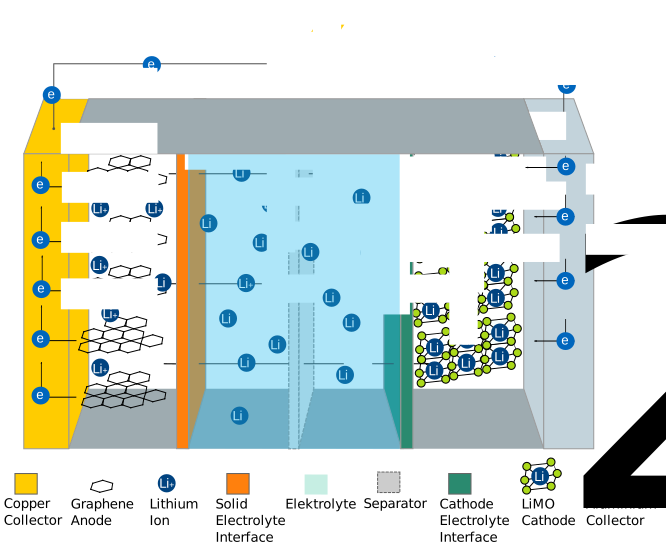
Lithium-Ion Battery
The most favorable battery type for ship propulsion is Lithium‑Ion Battery.
The Lithium‑Ion Battery is a generic term for a variety of similar batteries.
They all do have a graphite anode but different lithium compound cathode.
As electrolyte a non-aqueous liquid is used.
As of today, the Lithium‑Iron Phosphate (LiFePO4, LFP) is the most common.
Other types are:
The way of function for all subtypes is based on the lithium-ion intercalation
(or insertion), which is the process of moving lithium ions between the positive
(cathode) and negative (anode) electrodes of the battery during charging and
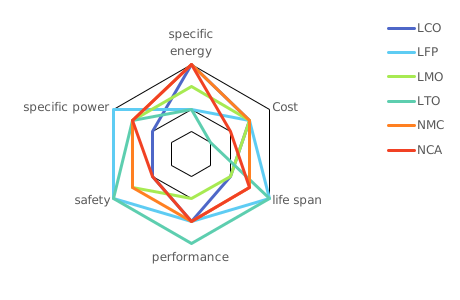
discharging. But due to their different materials, the characteristics, like
specific energy (gravimetric density), specific power, safety, performance,
life span, and cost, differs over a wide range.
The specific energy, the life span and safety are important characteristics
batteries used on a vessel for propulsion. Nevertheless, also the costs are
not negligible.
One single cell has a voltage between 2.4 V and 3.7 V,
they can be put together to modules and the modules can be stacked to
a battery pack, which will deliver the according voltage and provide the
storage capacity needed for propulsion of a ship. Coming to a battery pack,
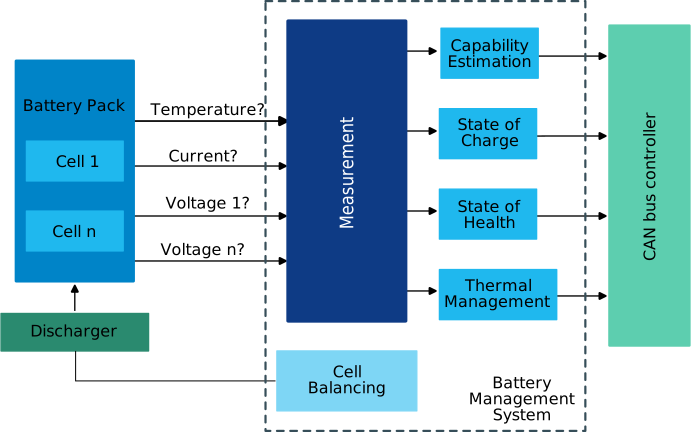
consisting of hundreds of cells, a battery management system (BMS) is needed,
which monitors and regulates the voltage, temperature, and current during
discharge and charge.
Average characterisics of different Lithium-Ion Batteries.
Emissions
When talking about emissions, there are initially different ways of looking
at them: On the one hand, a distinction is made between toxic and
climate-impacting emissions. On the other hand, a distinction is made
between local and global emissions. Examples of toxic emissions are
nitrogen oxides, particulates, formaldehyde, etc., while climate-impacting
emissions include CO2, methane, laughing gas, etc. Local emissions have
effects on the immediate surroundings of the source, such as toxicity.
The effects of global emissions are not limited locally; they can be
climate-impacting substances, for example, or the now banned CFC,
which damages the ozone layer or sulphur emissions from the seagoing
sector.
If the emissions caused by a propulsion technology or an energy source
are to be assessed, there are again various approaches. The most common
are the well-to-wake and the tank-to-wake approach. In the well-to-wake
approach, the emissions from the entire upstream chain required for the
production and supply of an energy carrier are considered. For an engine,
a fuel cell or a battery this approach is called Life-Cycle-Analysis.
The tank-to-wake approach looks at the emissions generated by the ship
during use. Everything that happened before the energy carrier,
storage system or energy converter came on board is excluded. These
two definitions can produce very different results in the assessment
of the technologies. For example, when considering the overall chain,
the choice of a methanol combustion engine could be better than that
of a battery-electric drive. This is the case if the production of the
battery causes more emissions than the combustion of methanol. It is
important to note that this type of consideration is also different
for each ship and depends on its operating time and energy requirements.
The following table shows the relevant emissions for this fact sheet.
Emission compared to conventional diesel
Local
Global
GHG
The global GHG emissions are dependent on the electricity source.
Also, a battery LCA is helpful to see the full story.
NOx
better
SOx
PM
Regulations
For inland waterway vessels the ES-TRIN 2025 Chapter 11 Special provision
applicable to electric vessel propulsion deals with regulations for electric
propulsion:
One electrical power source required for electric propulsion systems
with a single main propulsor
Two electrical power sources required for electric propulsion systems
with more than one main propulsors
Redundancy not generally required, however, independence of two electric
propulsion systems (where required by other provisions of the ES-TRIN,
e.g. for passenger vessels) only to be assumed if
Power supply circuits of the electric propulsion engines completely
separate from one another, OR
A FMEA-S safety study demonstrates that no failure of one electric
propulsion system impairs the operation of the other, OR
The electric propulsion systems can be separated from each other
by a separating device automatically activated in case of malfunction
or failure of one of the electric propulsion systems
Manually operated emergency shut-down device for each electric engine
Electrical power sources must be capable of absorbing power feedback
occurring during reversing manoeuvres
Generators, transformers and switchgear must be designed for temporary
overloads and the effects of manoeuvres according to their application
and operating conditions
Load changes, including brief overloads, and manoeuvres must not
impair safe operation of electric propulsion engines
Externally cooled power electronics must have emergency running
characteristics ensuring "steerageway under the vessel’s own power”
for at least 30 minutes. This requirement does not apply in the
presence of a second independent propulsion system (see above)
Control, indicating and monitoring requirements harmonised with
other propulsion systems and set up – as far as possible – in a
technologically neutral way (Article 7.04)
For integrated power management systems / energy supply systems
priority is required for systems necessary for the safe operation
of the vessel.
Test concept for electric propulsion systems to be developed by
the manufacturer or the system integrator, based on minimum requirements
defined in ES-TRIN.
Article 10.11 (17) (ES‑TRIN 2025) deals with the placement of
Li-Ion accumulators:
Rooms in which Li‑Ion accumulators are stored shall be protected
against fire of one or several Li‑Ion accumulators on the basis of
a fire protection concept developed by an expert.
A fire protection concept may be dispensed with if the Li‑Ion
accumulators are stored in a fireproof enclosure which is equipped
with at least one monitoring device (fire and thermal runaway) and
with one fixed fire extinguishing installation for protecting objects.
The rooms must be shielded with A60 partitions all round. The rooms
or the fireproof enclosures of Li‑Ion accumulators must be mechanically
ventilated to the open deck, the ventilation outlet shall be positioned
in such a way as to not endanger the safety of persons on board.
A fire protection concept or the protective measures described above
are not necessary if the cumulative capacity of the Li‑Ion accumulators
in the room is below 20 kWh.
Passenger vessels
ES-TRIN 2025 does not foresee specific requirements for passenger
vessels with regard to Li-Ion accumulators, the general requirements
in accordance with Chapters 10 and 11 apply.
ADN
The ADN under 1.1.3.7 foresees a general exemption from its provisions
concerning electric energy storage and production systems installed in
a means of transport, performing a transport operation and destined for
its propulsion or for the operation of any of its equipment.
Accumulators shall be located outside the protected area
(dry cargo vessels – 9.1.0.52.4) respectively outside the cargo area
(tank vessels (9.3.1.52.10). Ventilation openings of accumulator rooms
must comply with the safety conditions as specified in 9.1.0.12.3 to 9.1.0.12.6
(dry cargo vessels) and 9.3.1.10.4 and 9.3.1.12.4 to 9.3.1.12.6 (tank vessels)
of the ADN.
Technical Concept
Fixed batteries are suitable for hybrid ships and for ships with lower
energy requirements, such as day-trip ships, or with frequent charging
options, such as ferries. For large vessels on a relatively fixed route,
swappable battery containers can be a good option.
Pay-per-use swappable battery concept
Barges have a capacity varying from 500 to 1000 kW. With a ZESpack of 2600 kWh,
a barge can sail for 2 to 6 hours; or with 2 ZESpacks on board, it can travel
a distance of 60 to 120 km, depending on size and speed.
Within SYNERGETICS, the latest generation of ZES packs was equipped with the MCS
(Megawatt Charging System) connectors. Thisese plug standard is about to become the new
standard for megawatt charging not only in the maritime industry, but was mainly
developed in the automotive sector.
Battery management system (BMS)
The battery management system (BMS), represented on
, is an
electronic system that manages a rechargeable battery (cell or battery pack)
by enabling the safe use and long life of the battery in practical scenarios
by monitoring and estimating its various states (such as state of health
and state of charge), calculating secondary data, reporting this data,
controlling its environment, confirming, or balancing it. re).
The thermal management system ensures homogenous Cooling, equal
conditions for all cells by ventilation or liquid forced-flow.
This ensures long battery lifetime and is essential to avoid thermal
runaway (exothermal reaction battery cell due to internal failure).
Principle of a battery management system.
Charging time
The charging time of a battery depends on various factors. There are different
possibilities for charging, which also affect the type of installation in the ship.
Sufficient power must be available both for the electric load on board, possibly
including e.g. reefer containers, and for batteries to be charged. A generally
valid determination of the charging time as a function of the charging capacity
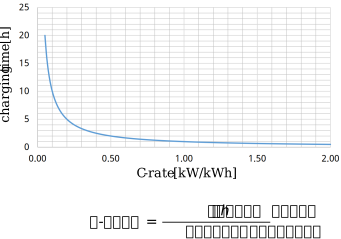
and the battery capacity to be charged is defined by the C‑rate.
The C‑rate defines
the charging or discharging power as a function of the battery capacity. 1 C
corresponds to a charging power at which the battery is fully charged in one hour.
C-rate of a battery.
Often there are different phases of charging. Firstly, the battery is protected
by charging it slowly to test whether the final discharge voltage is below the
critical threshold. After that the most part of the energy is supplied. At least
the rest of missing energy is added. For taking care of the battery, the intensity
of the current is degraded. During the charging process, there is always a loss in
heat and during further side reactions.
Concept for installation on board
Propulsion Concept.
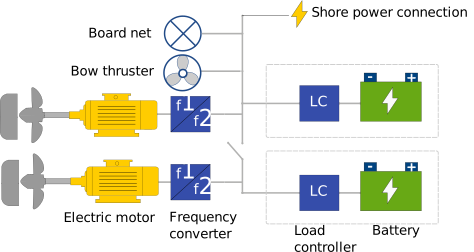
As it can be seen in
,
the electric motor (1) drives the propeller
with constant rpm (revolutions per minute) at any load case. Its advantage
is a nearly constant efficiency at all load cases. Depending on the selected
electric motor a gear box can be omitted. The frequency converter (2)
supplies the electric motor with a frequency and voltage amplitude variable
AC voltage. The converter can be supplied by any AC or DC on board energy
grid. The rotational speed of the electric motor is controlled by varying
the output frequency. The load controller (3) distributes the energy from
all sources to all loads. The loads are frequency converters at the
propulsion systems, bow thruster (5), board net (6), pump systems, etc..
It can be designed as a single AC or DC rail, which can be split in a
starboard and portside system. The batteries (4) can be charged via a
shore power connection (7).
Bunkering & Infrastructure
Nowadays, so-called power lock connectors are available for the shore
power connection. However, these are only suitable for fast charging a
battery to a limited extent, as there is a disbalance between the available
charging power and the size of the battery. The so-called megawatt charging
system would be more suitable. Here it is possible to charge with a charging
power of 1 MW to 4.5 MW. The plug and connection on the ship must be cooled.
So far, this system has only been tested for road transport, but for
charging the ZES power packs it is also in use.
Economics
The investment and operating costs are highly dependent on the individual
ship and its operational profile. Nevertheless, there are key figures for
some components. These are linked to a database so that they are updated
as soon as new information is available.
Investment Costs
The electrification of the propulsion system can cost, dependent on
the vessel size and system architecture, between 250,000 € and
2,000,000 €.
The investment for a fixed battery is between 750 € and 1000 € per kW.
Operational Costs
Currently, the price for electricity is between 0.1 € and 0.3 € per kWh.
However, the costs are very different locally.
Economic Drivers
At the moment, total costs of ownership are higher than fossil fuel
alternatives. ZES uses carbon-insetting programs, HBEs (Dutch for Renewable
energy units) and smart charging (potentially using the terminals’ PV) to
offer a competitive price. The expectancy of stricter regulations, CO2
pricing and the innovative concept can be economic drivers.
Considerations for Deployment
When is a fully battery-electric ship a good solution? What about partly
full-electric sailing?
Newbuild vs existing vessel
Existing vessels have to be retrofitted. Retrofitting costs are
significantly lower if vessel already has an electric drivetrain.
The vessels construction year and the drivetrain's age are two more
factors to consider
The additional expenses when choosing for battery-electric drivetrain
are lower for newbuild vessels, which can be designed optimally with the
given drivetrain technology in mind.
Cargo type
Container vessels are already designed to transport container,
making the integration of battery containers relatively easy for
both newbuild and refitting.
Dry bulk vessels require more effort to integrate with battery
containers, although very much possible, especially for newbuild.
Wet bulk vessels are generally not ‘refittable’ due to spacing
limitation and safety concerns. Newbuild wet bulk vessels might
be considered as niche market.
Container vessel sailing routes align better with charging
stations’ locations, which are situated at inland container terminals.
On the other hand, bulk vessels generally do not stop at inland
terminals, meaning they have to make extra stops (not always a problem
given occasional long waiting times).
Vessel size
For swappable battery containers larger vessels offer more return
on investment potential compared to smaller ones. Vessels below
1000 tons of loading capacity can be seen as unfeasible.
From ~1800 tonnes onwards the vessel's size does not play a
significant role anymore.
Concluding for swappable battery containers:
Container vessels generally have very high potential.
Larger dry bulk vessels that are sailing route align decently with
charging network are very feasible.
Wet bulk vessels are a niche market
Sailing with battery electric propulsion will give more and more
flexibility as battery technologies improve and charging station
are added to the network. This makes it less and less necessary to
rely on hybrid propulsion setups (for instance with gen-sets).
Deployment Examples
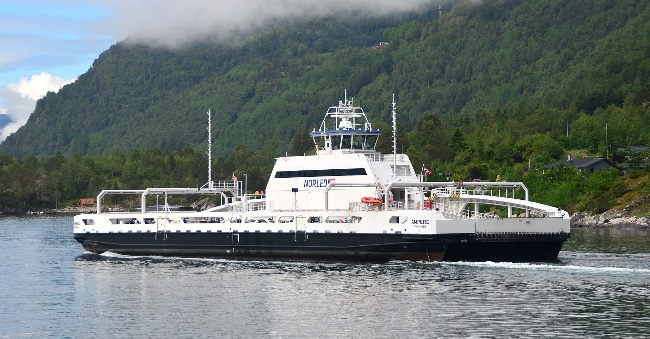
Ampere
Source: Wikimalte.
Vessel type
Ferry
IMO
9683611
Vessel Size
79.4 m × 21.44 m
Build Year
2015
Propulsion
2 x 450 kW
Battery Capacity
1040 kWh, charging at every crossing
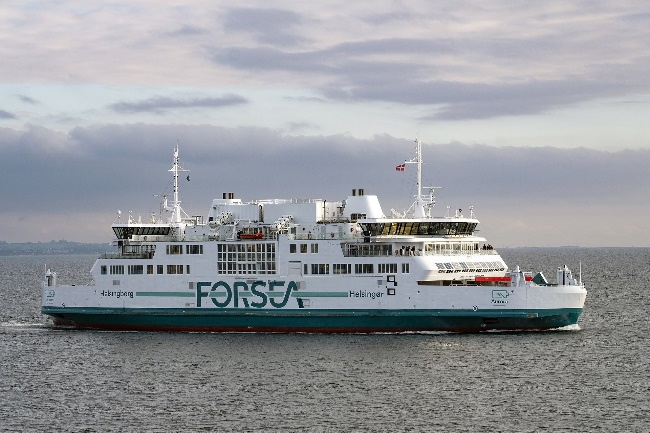
Aurora af Helsingborg
Source: News Oresund.
Vessel type
Ferry
IMO
9007128
Vessel Size
111.2 m × 28.22 m
Build Year
1992
Propulsion
4 x 1500 kW
Battery Capacity
4.160 kWh, automated charging at every crossing with 10.5 kV,
600 A and 10.5 MW
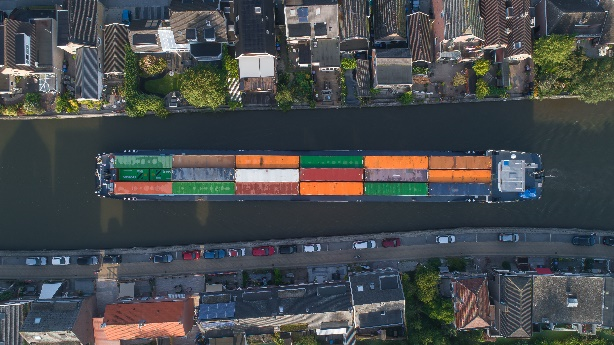
Alphenaar
Source: ZES B.V..
Vessel type
Container vessel
ENI
02338177
Vessel Size
90.0 m × 10.5 m
Build Year
2018
Propulsion
2 x 400 kW
Battery Capacity
2 ZES packs, 2600 kWh
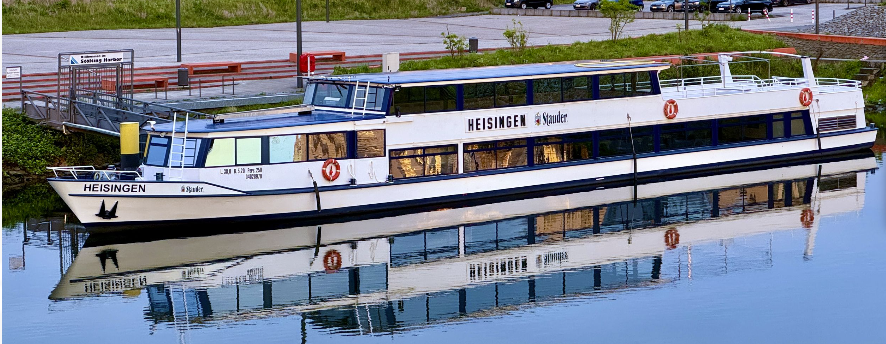
MS Heisingen
Source: Weiße Flotte Baldeney.
Vessel type
Day Cruise
ENI
04028970
Vessel Size
38.0 m × 5.2 m
Build Year
1985
Propulsion
2 x 10⁸ kW
Battery Capacity
570 kWh BMZ batteries
Project Coordinator
DST - Development Centre for Ship Technology and Transport Systems
Partners
SPB – Stichting Projecten Binnenvaart (NL)
Scandinaos AB (SE)
MARIN – Maritime Research Institute Netherlands (NL)
The content of the publication herein is the sole responsibility of the publishers and
it does not necessarily represent the views expressed by the European Commission or its
services. While the information contained in the document is believed to be accurate,
the author(s) or any other participant in the SYNERGETICS consortium make no warranty
of any kind with regard to this material including, but not limited to the implied
warranties of merchantability and fitness for a particular purpose. Neither the
SYNERGETICS Consortium nor any of its members, their officers, employees or agents
shall be responsible or liable in negligence or otherwise howsoever in respect of
any inaccuracy or omission herein.