


Introduction
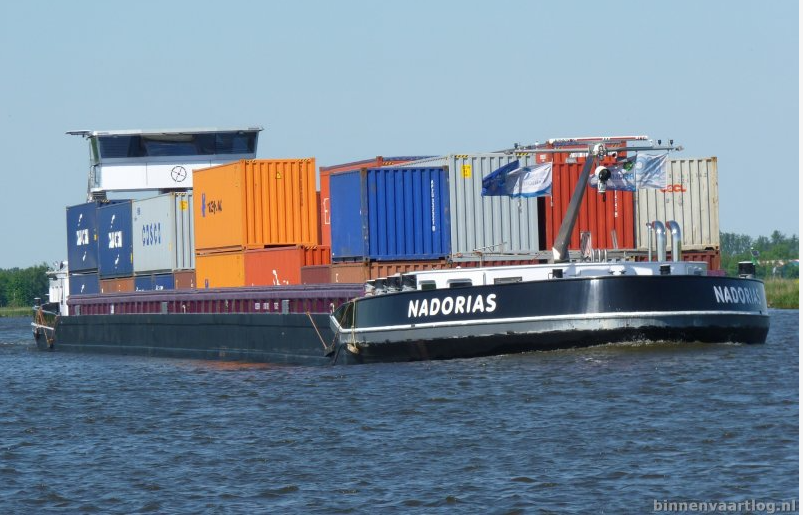
Today the large majority of inland and coastal vessels is equipped with internal combustion engines, the so-called diesel-direct propulsion. The engine torque most commonly is transmitted to the propeller via a gearbox or directly for slow-speed engines which can be reversed. These systems are technically mature, durable and cost-effective. Even if combustion engines with alternative fuels like methanol or hydrogen can be integrated analogue, “x-electric” drives (the “x” stands for any energy source) are increasingly being used in inland and coastal shipping, even despite the additional energy conversion brings additional losses. On the one hand, this is due to the complex operating profiles with very different power requirements, for example when sailing up and down rivers with fluctuation water depths. On the other hand, not all fuels and combustion processes are suitable for meeting the characteristics of the propeller in terms of rpm-dependent torque. In addition, an appropriately designed x-electric drive system can be adapted more flexibly to future developments in clean drives.
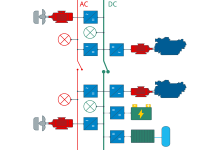
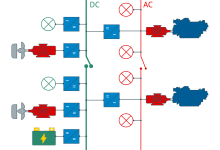
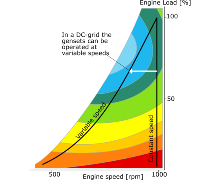
For the deployment of electric drives on board, products from numerous manufacturers are available in the required power range of 500 kW – 1200 kW for inland vessels and up to 10 MW for coastal vessels. If the individual technical requirements and boundary conditions of a ship cannot be covered by the manufacturer's portfolio, many manufacturers offer the option of having a customised drive built. In principle, DC motors or three-phase synchronous motors can be considered. The differences, advantages and disadvantages of the various motors and grid types are explained below.
Regulations
For inland waterway vessels, the ES-TRIN 2025 Chapter 11 Special provision applicable to electric vessel propulsion deals with regulations for electric propulsion:
- One electrical power source required for electric propulsion systems with a single main propulsor.
- Two electrical power sources required for electric propulsion systems with more than one main propulsors.
- Redundancy not generally required, however, independence of two electric propulsion systems (where required by other provisions of the ES-TRIN, e.g. for passenger vessels) only to be assumed if.
- Power supply circuits of the electric propulsion engines completely separate from one another, OR
- A FMEA-S safety study demonstrates that no failure of one electric propulsion system impairs the operation of the other, OR
- The electric propulsion systems can be separated from each other by a separating device automatically activated in case of malfunction or failure of one of the electric propulsion systems.
- Manually operated emergency shut-down device for each electric engine.
- Electrical power sources must be capable of absorbing power feedback occurring during reversing manoeuvres.